This blog is the third of a three-part series about the effects on birds from treating Nova Scotia hemlock forests with neonicotinoids. Part 1 examined the latest findings on the impact of neonicotinoids on human and wildlife health, as well as the regulatory responses in the Western world. Part 2 explored the potential effects of neonicotinoids on Nova Scotia hemlock forest birds, and Part 3 reports on what birds tell us about that forest’s future.
A self-organized group of citizen scientists began designing a baseline breeding bird study throughout the province of Nova Scotia in areas of initial or pre-infestation of Eastern Hemlock stands by the Hemlock Woolly Adelgid. We hoped that these surveys could assist in developing a bird conservation management plan to mitigate the effects of the adelgid. By 2019, two years after the first discovery of the adelgid in the province, with the support of the Nova Scotia Bird Society, volunteer expert birders throughout the province had begun conducting breeding bird surveys using a point-count methodology and passive acoustic monitoring over four years. These surveys became part of a broader citizen science initiative, the Listening Together Project, which received financial support from the Canada Nature Fund of Environment and Climate Change Canada. The Nova Scotia Department of Natural Resources provided administrative support.
We expected to find an avian population similar to those documented by scientific surveys, under pre-infestation conditions, throughout Eastern North America, and dominated by the iconic Blackburnian Warbler. To our surprise, we found a severely altered avifauna and a steeply declining population of Blackburnian Warblers.
The Modern History of Hemlock Breeding Birds in Nova Scotia
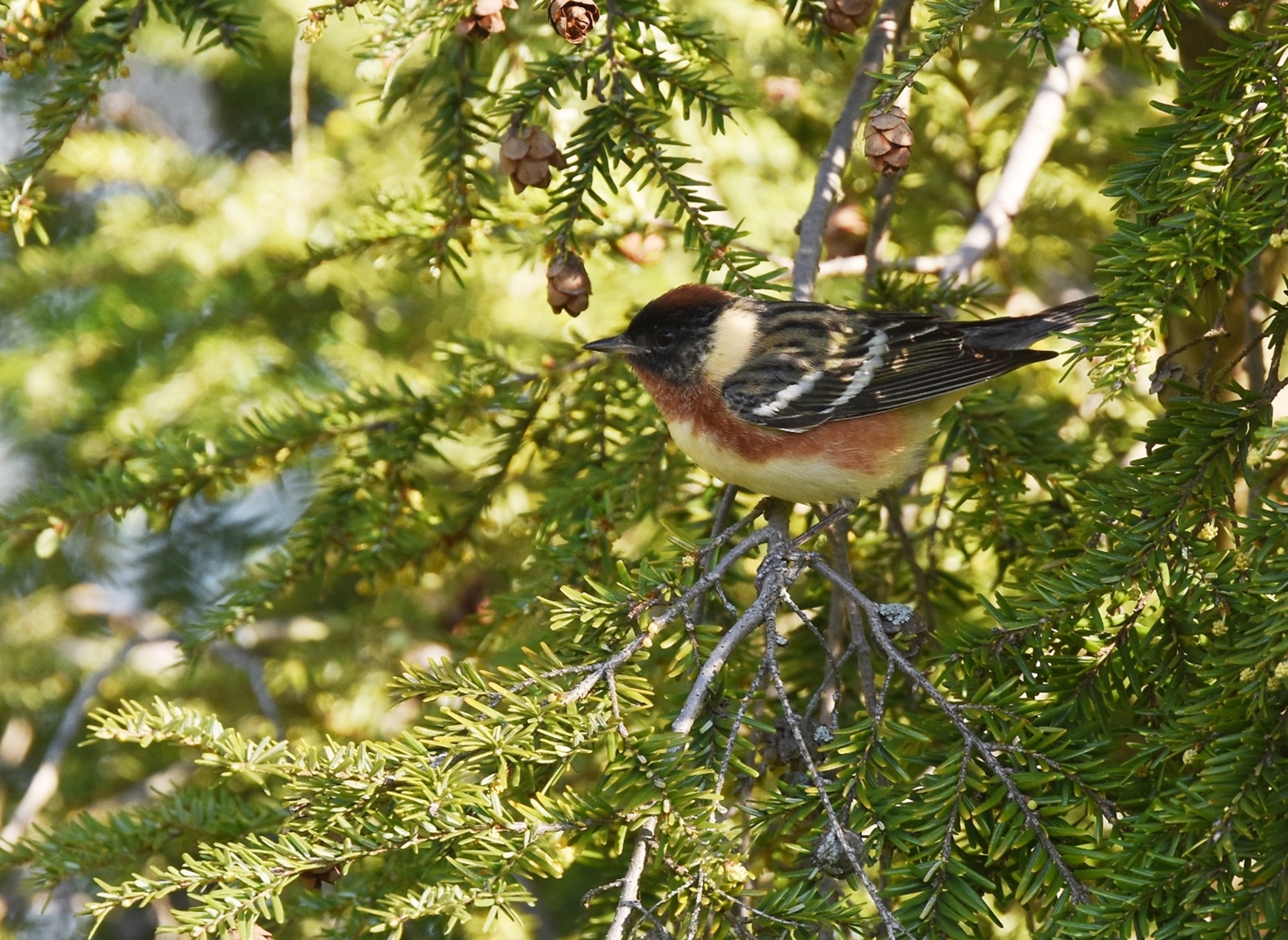
The scientific literature identifies four bird species closely associated with Eastern Hemlock forests, which extend from the southeastern United States north to Ontario and Nova Scotia. These are the Blackburnian Warbler, the Black-throated Green Warbler, the Blue-headed Vireo, and the Acadian Flycatcher. In Nova Scotia, the Bay-breasted Warbler replaces the Acadian Flycatcher, which does not occur in Nova Scotia.
Bird species are indicators of forest structure and health (Duclos 2023). Among the three hemlock specialists, the Blackburnian Warbler stands out as the most critical bird species indicator of mature and old-growth hemlock stands. The rest of this history thus focuses on the changes in Blackburnian Warbler populations in the Eighteenth to Twenty-first Centuries.

Before the arrival of European settlers, the Indigenous cultures of North and South America recognized the Blackburnian Warbler as a small forest bird, which they referred to as the “firebird” or “flame bird.” The Mi’kmaq name is Puktewji’j, as I learned from a Mi’kmaw speaker, Tuma Young. The pronunciation is “Book-doh-jeej.” The English translation is “the little bird that brought fire.”

One might think that the word Blackburnian refers to its black and burning colours, but in fact it is an eponymous name in honour of Anna Blackburne. She was born into a wealthy family in England in 1726. She became a collector of natural history specimens. Her brother sent her bird carcasses from New York, where he lived. Thomas Pennant, a Welsh naturalist, examined the collections of Anna Blackburne and named the Blackburnian Warbler in her honour (Wystrach 1974).
The American Ornithological Society (AOS) has begun a process to eliminate all eponymous bird names in this hemisphere (Remmel 2022). Numerous birds are named after individuals who owned slaves, were known for pillaging Indigenous burial sites, or led massacres of Indigenous communities. However, the AOS, in consultation with diverse groups, will change all eponymous names to disassociate them from their colonial history and assign birds names that highlight their unique qualities. Thus, this essay will at times refer to the Blackburnian Warbler as Puktewji’j as a reminder of our journey as treaty people in the pursuit of reconciliation.
In 1888, a Harvard University ornithologist, William Brewster, wrote that the Blackburnian Warbler is the most abundant bird in hemlock stands, outnumbering the Black-throated Green Warbler. This species was so plentiful in hemlock stands that, in 1908, an American naturalist, Ora Knight, considered them a colonial species (Bent 1953).

The first published study on hemlock birds in Canada was in Ontario’s Algonquin Park in 1952 (Martin 1956, 1960). The breeding density of Blackburnian Warblers was 25.20 males per 10 hectares. The density of the Black-throated Green Warbler was considerably less at 6.92 males per 10 hectares. A summary of studies conducted between the late 1940s and early 1970s reported that the average densities of Blackburnian Warblers in the hemlock stands of Ontario, Quebec, and Nova Scotia were 11.8 males per 10 hectares and 6.7 males per 10 hectares for Black-throated Green Warblers (Erskine 1977).

The first published study of hemlock-breeding birds in Nova Scotia was a comprehensive bird survey conducted in Kejimkujik National Park from 1971 to 1972 (Lunn 1977). For hemlock birds, the primary field methodology was the use of permanent sample plots. As shown in Table 1, the density of Blackburnian Warblers (9.38/10 ha) was much greater than all other species. As expected, the Black-throated Green Warbler was the second most common species (5.94/10 ha), and the Bay-breasted Warbler was the third most common species (5.19/10 ha).
Nowhere else in North America are Bay-breasted Warblers a hemlock specialist. As the author of this study noted, the Bay-breasted Warbler prefers the oldest conifers in a forest, and the hemlocks in Kejimkujik met this criterion. The author also indicated that they preferred the lowest branches of the trees. This part of the tree is the niche of the Acadian Flycatcher in the United States hemlock forests, suggesting the Bay-breasted Warbler is taking advantage of the absence of this species in Nova Scotia. The author reports substantial cut-over areas within and adjacent to the hemlock stands, which attract birds such as the Magnolia Warbler, Least Flycatcher, Ovenbird, Red-eyed Vireo, and Northern Parula.
The next published study of birds nesting in hemlock stands in Nova Scotia was 18 years later and was a joint venture of the Mersey Bowater Paper Company Limited and Acadia University (Deal 1993). Two expert birders from the Nova Scotia Bird Society surveyed forest stands containing 75-100% hemlocks using a point-count methodology during the 1990 breeding season in the Rossignol region of Southwest Nova Scotia. The author notes that Blackburnian Warblers are the dominant species in the hemlock forest.
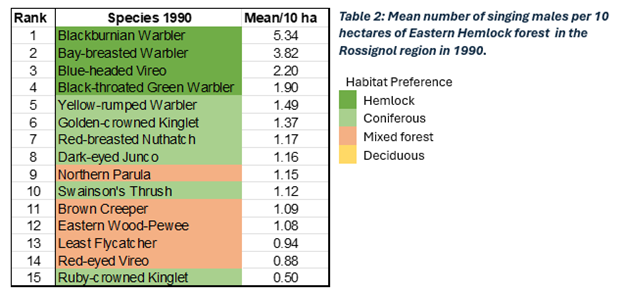
As shown in Table 2, the hemlock specialists were the top four breeding species. Compared to the hemlock survey at Kejimkujik National Park in the 1970s, the Rossignol forest had considerably reduced densities of specialist species, with the Blackburnian Warblers falling from a mean of 9.38 per 10 hectares in Kejimkujik National Park to 5.34 in the Rossignol. It is essential to note that breeding densities of forest birds are challenging to determine and should be viewed with caution when comparing densities calculated using different methods. However, I use them here since they are sufficiently different over several decades to indicate the changes in the size of bird populations over a long time frame. Table 2 also shows that coniferous bird species constituted a greater proportion of the hemlock forest in the Rossignol than in Kejimkujik. This difference may be the result of the high percentage of hemlocks in the Rossignol stands and the apparent lack of disturbed areas. One can also see that the Bay-breasted Warbler was the second most abundant species in the Rossignol.
Parks Canada began annual breeding bird surveys in Kejimkujik National Park in 2003. There do not seem to be any published summaries or analyses of these surveys. However, two environmental assessments related to the Hemlock Woolly Adelgid infestation list the Bay-breasted Warbler, Black-throated Green Warbler, and Blackburnian Warbler as hemlock specialists (Parks Canada 2021, 2023). In 2002, a heavy infestation of the moth Pale Winged Grey caused a decline in these hemlock specialists (Parks Canada 2021). However, there were no reports of heavy infestations elsewhere that might affect bird populations (Nova Scotia Natural Resources 2005).
The Maritimes Breeding Bird Atlas indicates that in Southwest Nova Scotia, the area of focus in this report thus far, there were increases in the hemlock specialists between the first atlas period (1986-1990) and the second period (2006-2010) (Stewart et al. 2015).
Thus, in concluding this historical section, the Maritimes Breeding Bird Atlas, without reference to specific hemlock forests, indicates a stable or increasing trend overall relative to the four species that represent the hemlock specialists. The limited data provided by the hemlock surveys reported in this report show a marked decline in the number of these same species in hemlock stands since the 1950s.
The Arrival of the Hemlock Woolly Adelgid and Its Possible Effects on Bird Populations
In 2017, scientists first found the presence of the Hemlock Woolly Adelgid in Nova Scotia, seven years after the conclusion of the second Maritimes Breeding Bird Atlas. Previously, few studies in the United States had examined the effect of the adelgid on bird populations, both in stands treated and non-treated with insecticides. A before-and-after study in the Delaware Water Gap National Recreation Area, located on the Pennsylvania-New Jersey border, was the most conclusive and highly relevant to Nova Scotia.
The first study took place in 2000 in hemlock stands in the early stages of infestation by the adelgid (Ross et al. 2004). Similar to Nova Scotia, Blackburnian Warblers, Black-throated Green Warblers, Acadian Flycatcher, and Blue-headed Vireos dominated hemlock stands.
Scientists repeated the study in 2015 and 2016 (Toenies et al. 2018). The study found that the infestation resulted in a decline of total hemlock basal area and a shift in forest structure, characterized by an increased deciduous understory. The occupancy of hemlock specialists declined significantly, while bird species associated with shrub layers, forest edges, and mature deciduous forests increased similarly. Species of the deciduous forest, particularly Ovenbirds and Red-eyed Vireos, increased. The adelgid’s overall effect was a homogenization of the hemlock stands with the surrounding deciduous forest.
We expected the results of our baseline study to be similar to the “before” study in the Delaware Water Gap National Recreation Area. However, this was not to be the case.
Methods
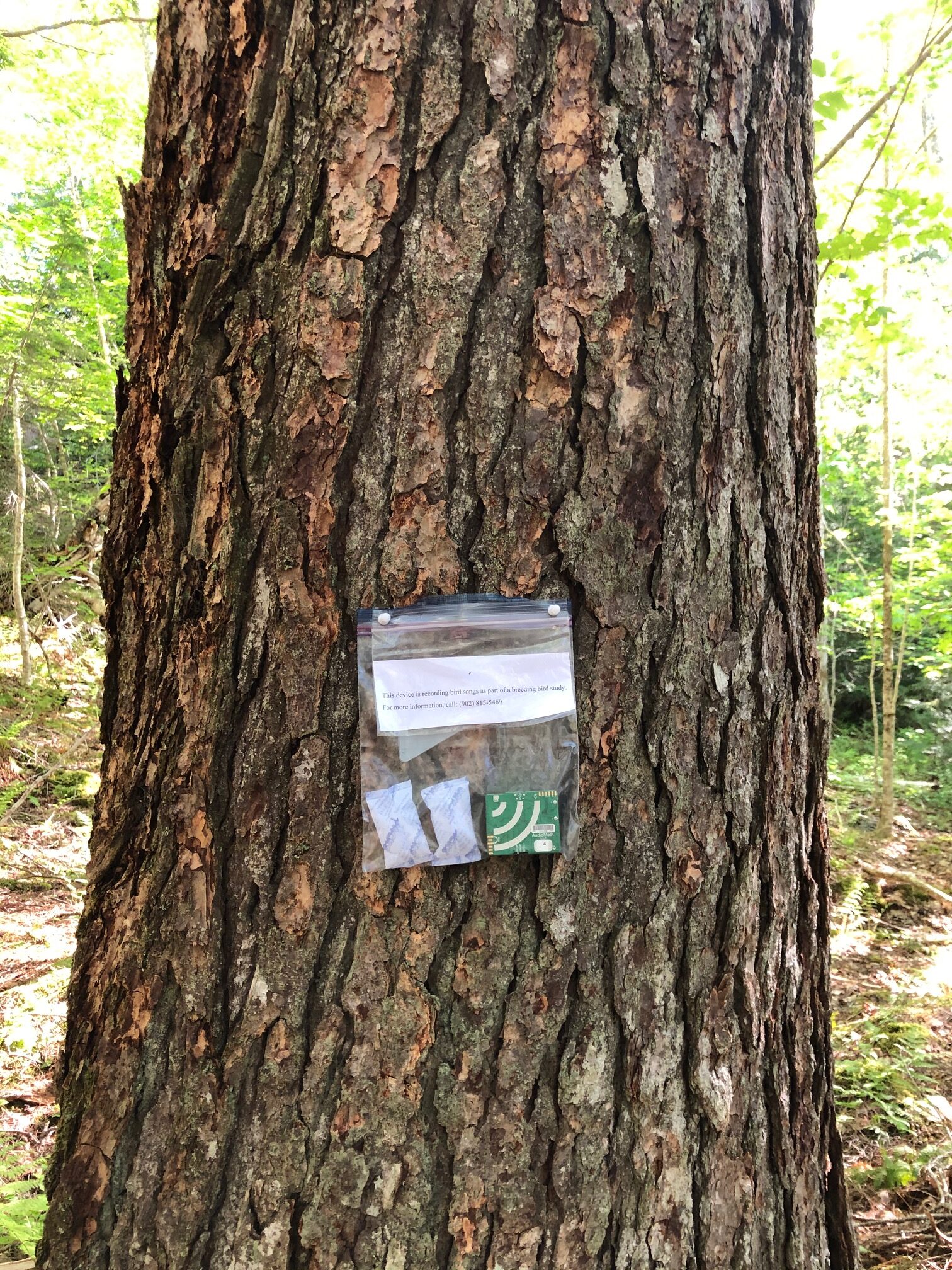

Survey participants could use one or both of two survey methods: point counts and automated recording units. Most participants were familiar with the point count methodology, as they had likely participated in the Maritimes Breeding Bird Atlas and the North American Breeding Bird Survey, which also use the point count method. On the other hand, only three participants had previously used automated recording units. I provided participants with an AudioMoth, a low-cost, easy-to-use unit developed by Open Acoustics (Hill et al. 2018). BirdNET Analyzer detected and classified the acoustic recordings (Kahl et al. 2021). You can learn more about the methods in the full report (The Listening Together Project 2025).


The Google Earth map (above) shows the 26 locations where participants surveyed breeding birds in hemlock stands, either by point counts, AudioMoths, or both. There were 20 locations where participants conducted a total of 123 point counts. Additionally, participants deployed AudioMoths at 20 locations, resulting in 245 hours of recordings. Table 3 summarizes the location data.
Results
Point Count Results
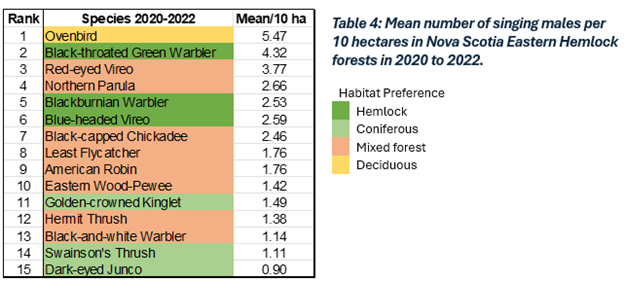
Notwithstanding the challenges in calculating bird densities in forests, I estimated the mean density of breeding birds across the 20 point count study locations for comparison with the studies conducted in 1971-1972 and 1990. This calculation used the densities within 100-meter radius circles to determine a mean density for 10 hectares from 2020 to 2022. Table 4 presents the densities of the 15 top species.
One sees a dramatic shift in dominance from hemlock specialists and coniferous birds to deciduous and mixed forest species. The Bay-breasted Warbler disappears from the top 15 species, and the Blackburnian Warbler falls from first to fifth place, with the density of singing males at 27% of their 1971-1972 levels recorded at Kejimkujik National Park. The other two hemlock specialists, the Black-throated Green Warbler and the Blue-headed Vireo, are 73% and 66% of their 1971-1972 levels, respectively. Ovenbirds become the dominant species at 275% of their 1971-1972 levels, and the top four species now have only one hemlock specialist and three deciduous or mixed forest species.
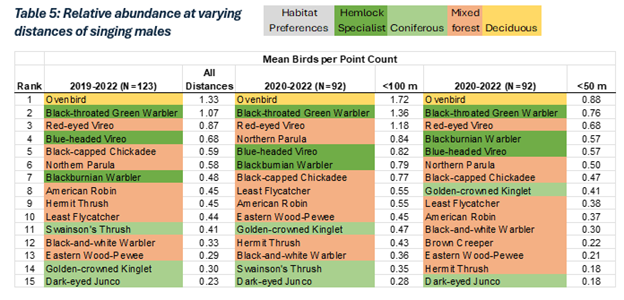
During our study period, a more reliable metric is the relative abundance of each species, based on the mean number of birds per point count at various distances from the observer. Table 5 lists the mean birds per point count of the top fifteen species at all distances, within 100 meters, and 50 meters.
In all three distance categories, the three most abundant species are the Ovenbird, Black-throated Green Warbler, and Red-eyed Vireo. The Blackburnian Warbler is the 7th most abundant at all distances, 6th at less than 100 meters, and 4th (tied with Blue-headed Vireo) at less than 50 meters. These numbers demonstrate the decline of the Blackburnian Warbler from its former dominance among hemlock bird species.
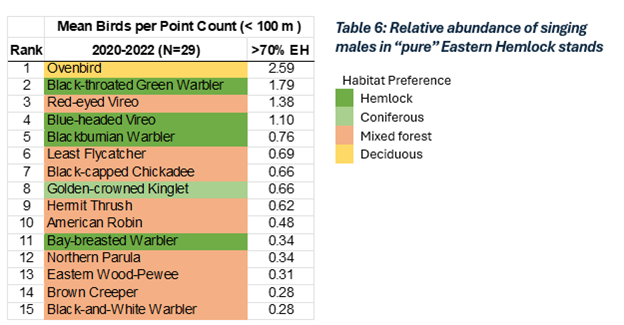
Black-throated Green Warblers maintain their historic position as the second most dominant species. At the same time, the Blue-headed Vireo struggles to maintain fourth position over the mixed-forest warbler, the Northern Parula. What is most dramatic in the present hemlock forest bird community is the overwhelming dominance of the Ovenbird. One might argue that this shift could be due to the disturbed areas in hemlock stands, allowing for a more prominent shrub layer in this habitat for this species. However, the data in Table 6 does not seem to support this hypothesis.
This table shows the mean number of birds per count per species within 100 meters in a forest stand with more than 70% hemlock, or what some might call a “pure” hemlock stand. The mean number of Ovenbirds is even greater than in the stands greater than 50%, and the relative abundance of Blackburnian Warbler falls by one place from fourth to fifth compared to the 50% stands. However, in the pure stands, the Bay-breasted Warbler returns to the top fifteen species, ranking eleventh at a mean count of 0.34 birds.

Another metric for understanding the breeding bird population in hemlock stands is occupancy. In this study, occupancy refers to the presence of at least one singing male at a point count site between May 25 and July 5 during a specific breeding season. Table 7 presents occupancy rates at point count sites, calculated at all distances and distances less than 100 meters.
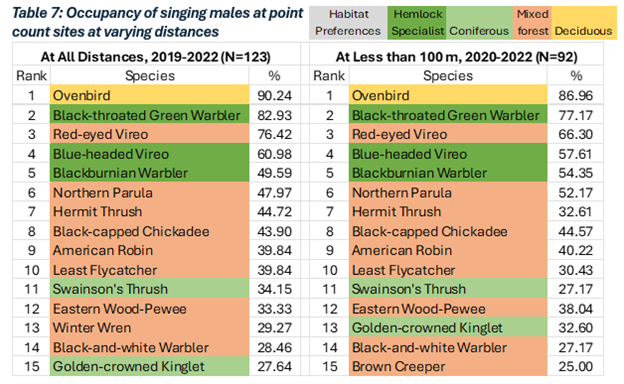
The rankings of the relative abundance of species according to occupancy are very similar at all distances and less than 100 meters. Indeed, they are identical for the top 12 species. In comparison, the rankings of relative abundance based on the mean number of birds per point count, as shown in Table 5, vary significantly according to distance from the observer.
Thus, the occupancy data indicate that a project participant in their two visits to a point count site in a specific year has about a 90% chance of hearing an Ovenbird, an 80% chance of hearing a Black-throated Green Warbler, a 70% chance of hearing a Red-eyed Vireo, 60% chance of hearing of Blue-headed Vireo, and a 50% chance of hearing a Blackburnian Warbler. Surprisingly, the observer has about an equal chance of hearing a Northern Parula, a mixed-forest species, in a hemlock stand as they do of hearing a Blackburnian Warbler.
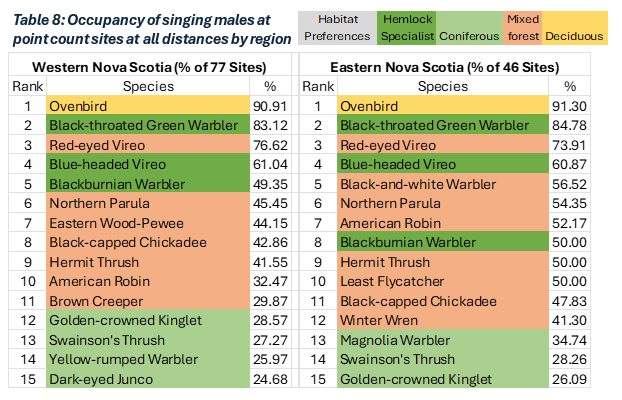
Table 8 splits occupancy rates into two regions of Nova Scotia. The western region includes point count sites in the counties of Shelburne, Annapolis, and Kings, while the eastern region includes the counties of Halifax and Cape Breton. The four top-ranked species in both regions mirror the results at all distances for the province as a whole, as shown in Table 7. The rank and proportion of singing males differ greatly for ranks 5 to 15. In the Eastern region, there is a 50% chance of hearing a Blackburnian Warbler, which ranks eighth, after the Black-and-white Warbler, Northern Parula, and American Robin, which have slightly higher chances. In the Western region, there is a 49% chance of hearing a Blackburnian Warbler which ranks 5th in that region. There is a 44% chance of hearing an Eastern Wood-Pewee in the west and only a 14% chance of hearing a Least Flycatcher (less than 15 in rank). In the east, the situation is the opposite, with a 50% chance of hearing a Least Flycatcher and only a 15% chance of hearing an Eastern Wood-Pewee (less than 15 in rank). Eight species occur in the top 15 ranks in only one of the two regions: Eastern Wood-Pewee, Least Flycatcher, Brown Creeper, Yellow-rumped Warbler, Dark-eyed Junco, Winter Wren, Magnolia Warbler, and Black-and-white Warbler.
Passive Acoustic Monitoring Results
Since it is very difficult to count individual birds in audio recordings, the analysis of acoustic monitoring focuses on occupancy.
Participants deployed AudioMoths at 20 locations. Deployments included one AudioMoth for just one breeding season at 14 locations, two seasons at three locations, three seasons at one location, and 2 AudioMoths at one location for one season. On average, the AudioMoth recorded for 30 minutes for 20 mornings at each location.

Table 9 shows the occupancy of singing males at the 25 recording sites over multiple years. The relative abundance of species differs from that for point counts in several ways.
First, BirdNET identified a Black-throated Green Warbler at all of the 25 sites, and the Blackburnian Warbler and Ovenbird tied for second place with a presence at 24 sites. Second, the Hermit Thrush rose to fourth place, three to eleven ranks higher than in the point counts. The Blue-headed Vireo was at about the same ranking as in the point counts, but the Red-eyed Vireo fell by four ranks. The Northern Parula fell considerably compared to most point count rankings, except for the “pure hemlock.”
However, a closer examination of the singing activity at each of the recording sites suggests a need to drill deeper into the data to gain a more comprehensive understanding of the occupancy rates derived from the acoustic recordings.
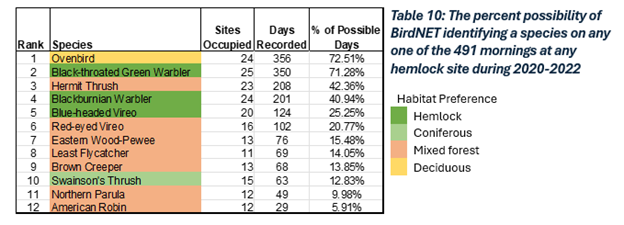
Table 10 compares the occupancy rates of a species and the chances of a recording identifying the song of that species on any given day at any site from May 25 to July 5 in any year of the study.
The twelve species listed in Table 10 are those for which BirdNET exhibited near 100% precision in their species classification. The rankings in Table 10 begin to resemble those for point counts more closely. With a 41% possibility of being identified by BirdNET on a given day, the Blackburnian Warbler is close to the 50% chance of hearing this species during a point count. Nonetheless, the Hermit Thrush still ranks much higher and the Red-eyed Vireo much lower than in the point counts.
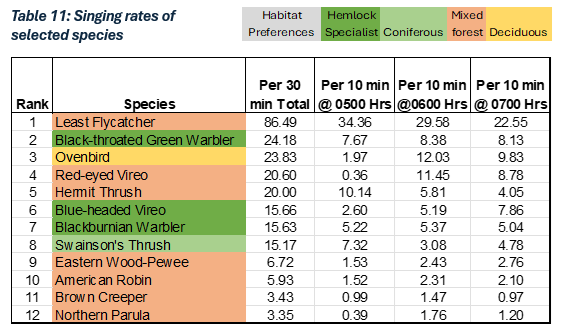
In Table 11, one can compare the singing rates of the Hermit Thrush with those of the other top 12 species, which are near 100% precision, in the acoustic recordings. One can see that the Hermit Thrush sings about twice as frequently at 0500 hours as it does at 0600 hours and 0700 hours. Only one participant conducted their surveys at 0500 hours. This fact likely explains the lower ranking of the Hermit Thrush in the point count surveys.


Similarly, the singing rates of Red-eyed Vireos at 0600 hours and 0700 hours are considerably greater than those for Blue-headed Vireos. Like the high singing rates for the most abundant species, such as the Black-throated Green Warbler and Ovenbird, this tendency might suggest that there are often two or more Red-eyed Vireos at a site. However, this possibility must be treated with caution, as this species is renowned for its persistent singing. The Blue-headed Vireo also sings frequently but is not as persistent.
Discussion
At the beginning of our study, we expected to find an avifauna in the hemlock forest consisting of hemlock specialists, coniferous species, and some mixed forest species in disturbed portions. Instead, we found that one of our most deciduous-loving birds, the Ovenbird, was the dominant species in the hemlock forest. Our point-count analysis revealed that the hemlock specialist, the Black-throated Green Warbler, maintained its historic position as the second most abundant species. The Red-eyed Vireo and Northern Parula, two mixed forest species, jockeyed in position for third and fourth place with the other hemlock specialists, the Blackburnian Warbler and Blue-headed Vireo. The Bay-breasted Warbler, the fourth hemlock specialist, disappeared from the top fifteen species. With some variations, the acoustic analysis based on occupancy rates confirms the same pattern. Still, it adds the Hermit Thrush, as another mixed forest species, to the top portion of the relative abundance rankings.

Puktewji’j, the little bird that brought fire, has been a focal point of this analysis due to their iconic status and significance as the most notable indicator of avifaunal change in the Eastern Hemlock forest. The European naturalists of the 18th Century gave Puktewji’j a new name in honour of a colonial collector of New World flora and fauna. They wrote about their superabundance in the hemlock forest. It wasn’t until the 1950s that scientists began to quantify that abundance.
The abundance of Puktewji’j was as high as 25.20 singing males per 10 hectares, with an average density of 11.80, in Eastern Canada during the 1950s and 1960s. Studies in Nova Scotia have shown a decline in density from 9.38 per 10 hectares (early 1970s) to 5.34 (1990) and then to 2.53 (2020-2022), resulting in a population loss of 73.03%. Although the number of studies is limited, these densities represent a 79% decline in their hemlock populations since the 1950s. As terrible as this sounds, it may be an underestimation.
A recent paper on forest degradation in the Maritime Provinces (Betts et al. 2022) shows significant habitat degradation for seven coniferous species since 1985. Degradation occurs when there is a reduction in mature and old-growth forests, as well as the simplification of their structure and composition. Degradation leads to loss of bird habitat and population declines. The study shows that Puktewji’j has lost 33% of its habitat and 70% of its population just since 1985. Thus, our estimate of a 79% decline in hemlock stands over 70 years may be consistent with the overall decline in this species. The authors also note a discrepancy between the percentage loss of habitat and the loss of population. They suggest that other factors, such as increased migration mortality due to building collisions, worsening climate effects, environmental contaminants, and loss of migratory stopover and winter habitats, may be aggravating factors in addition to the loss of breeding habitat. Alarmingly, as Betts et al. (2022) point out, this significant gap between habitat loss and population loss can also signal a potential threat of extinction.
Thus, Puktewji’j is telling us that the hemlock forest in Nova Scotia is critically degraded and can no longer support their community or other coniferous forest bird communities as it once did. This degradation occurred before the arrival of the Hemlock Woolly Adelgid.
While we don’t know the reasons for this degradation, it is imperative to understand its most essential elements, which may include, but are not limited to: forestry practices, forest fragmentation, forest homogenization, deer overgrazing, declining lepidoptera and other insect populations, and climate change. The treatment of hemlock stands with neonicotinoids may further this degradation through the disruption of key ecological processes in the forest canopy, soil, and water.
Rachel Carson shocked the world with her description of the destructive effects of pesticides in her book Silent Spring (1962). But Carson’s target was also the scientists in a close relationship with chemical companies, ignoring ecological principles, believing that they had the power to control Nature for their own convenience.
David Foster, the former Director of the Harvard Forest, where ecologists have conducted decades of research on Eastern Hemlock, expressed a similar sentiment when he wrote that we may believe that we have the knowledge and capacity to assist Nature in its recovery from the loss of trees attacked by insects, flames, or wind. He goes on to say that, in adopting an ecological approach, we might instead see this destruction as part of Nature’s history, a beneficial, temporary event, leading to a new, fully functional forest, offering new ecological opportunities (Foster 2014).
Moving ahead with the treatment program of the hemlock forest in Nova Scotia without the research that would have identified the severe declines of key coniferous bird species and the shift to mixed and deciduous forest birds indicates that we made such a decision, convinced of our power to control Nature and without adequate knowledge of the forest transformation that had already begun and its potential ecological consequences.
Finally, in concluding this blog series, I want to thank the volunteer experts who carried out the bird surveys over four years. Their knowledge of bird identification, ability to identify their songs, and willingness to acquire new skills in deploying AudioMoths led to a study with comprehensive coverage and high-quality results. Some of these participants may not agree with my interpretation of the results, which is my responsibility alone. You can read their full report here.
May what I have written be of use to you.
References
Bent, Arthur Cleveland. 1953. Life Histories of North American Wood Warblers, Part One. Edited by Smithsonian Institution United States National Museum. Vol. Bulletin 303. United States Government Printing Office.
Betts, M. G., Z. Yang, A. S. Hadley, A. C. Smith, J. S. Rousseau, J. M. Northrup, J. J. Nocera, N. Gorelick, and B. D. Gerber. 2022. “Forest degradation drives widespread avian habitat and population declines.” Nature Ecology & Evolution 6 (6): 709–719. https://www.ncbi.nlm.nih.gov/pubmed/35484222.
Carson, Rachel. 1962. Silent Spring. Boston: Houghton Mifflin. https://library.uniteddiversity.coop/More_Books_and_Reports/Silent_Spring-Rachel_Carson-1962.pdf.
Deal, John A. 1993. Wildlife and Forests of the Rossignol: A Study of their Associations. (Liverpool, Nova Scotia: Bowater Mersey Paper Company Limited).
Duclos, Tim. 2023. “Birds as Indicators of Forest Ecosystem Health.” Vermont Audubon. https://vt.audubon.org/news/birds-indicators-forest-ecosystem-health.
Erskine, Anthony J. 1977. Birds in Boreal Canada: Communities, Densities, and Adaptations. (Ottawa: Canadian Wildlife Service.). http://www.parkscanadahistory.com/wildlife/report-41.pdf.
Foster, David R., ed. 2014. Hemlock. A Forest Giant on the Edge. New Haven, Connecticut: Yale University Press.
Hill, Andrew P., Jake L. Snaddon, Peter Prince, Evelyn Piña Covarrubias, C. Patrick Doncaster, and Alex Rogers. 2018. “AudioMoth: Evaluation of a smart open acoustic device for monitoring biodiversity and the environment.” Methods in Ecology and Evolution 9: 1199–1211. https://doi.org/10.1111/2041-210X.12955.
Kahl, Stefan, Connor M. Wood, Maximilian Eibl, and Holger Klinck. 2021. “BirdNET: A deep learning solution for avian diversity monitoring.” Ecological Informatics 61. https://doi.org/10.1016/j.ecoinf.2021.101236.
Lunn, Simon. 1977. “Avifaunal Survey of Kejimkujik National Park, 1971-72.” Masters of Science, Acadia University.
Martin, N. D. 1956. “An Analysis of Bird Populations in Relation to Plant Succession in Algonquin Park, Ontario.” PhD, University of Illinois.
—. 1960. “An Analysis of Bird Populations in Relation to Forest Succession in Algonquin Provincial Park, Ontario.” Ecology 41 (1): 126–140. https://doi.org/https://doi.org/10.2307/1931946. https://esajournals.onlinelibrary.wiley.com/doi/abs/10.2307/1931946.
Nova Scotia Natural Resources. 2005. Pale Winged Grey: Iridopsis ephyraria (Wlk.). Shubenacadie, Nova Scotia: Integrated Pest Management, Nova Scotia Natural Resources.
Parks Canada. 2021. Active Management of Hemlock Woolly Adelgid. Detailed Impact Assessment. Kejimkujik National Park and National Historic Site.
—. 2023. Active Management of Hemlock Woolly Adelgid. Detailed Impact Assessment Amendment. Kejimkujik National Park and National Historic Site.
Remmel, Ariana. 2022. “What’s in a Bird Name.” Audubon. https://www.audubon.org/magazine/whats-bird-name.
Ross, Robert M., Lori A. Redell, Randy Bennett, and John A. Young. 2004. “Mesohabitat use of threatened hemlock forests by breeding birds of the Delaware River basin in northeastern United States.” Natural Areas Journal 24 (4): 307–315. https://pubs.usgs.gov/publication/70026657.
Stewart, R.L., K.A. Bredin, A.R. Couturier, A.G. Horn, D. Lepage, S. Makepeace, P. D. Taylor, M.-A. Villard, and R.M. Whittam. 2015. Second Atlas of Breeding Birds of the Maritime Provinces. Sackville, N.B.: Bird Studies Canada, Environment Canada, Natural History Society of Prince Edward Island, Nature New Brunswick, New Brunswick Department of Natural Resources, Nova Scotia Bird Society, Nova Scotia Department of Natural Resources, and Prince Edward Island of Department of Agriculture and Forestry. www.mba-aom.ca.
The Listening Together Project. 2025. A Baseline Study of the Breeding Birds In Eastern Hemlock Stands of Nova Scotia Upon the Arrival of the Hemlock Woolly Adelgid. (John F. Kearney & Associates). https://www.carjohnfkearney.com/Reports/Final%20Report.pdf.
Toenies, Matthew J., David A. W. Miller, Matthew R. Marshall, and Glenn E. Stauffer. 2018. “Shifts in vegetation and avian community structure following the decline of a foundational forest species, the eastern hemlock.” The Condor: Ornithological Applications 120 (3): 489–506. https://doi.org/10.1650/condor-17-204.1. https://doi.org/10.1650/CONDOR-17-204.1.
Wystrach, V. P. 1974. “A note on the naming of the Blackburnian warbler.” Journal of the Society for the Bibliography of Natural History 7 (1): 89–91. https://doi.org/10.3366/jsbnh.1974.7.1.89. https://doi.org/10.3366/jsbnh.1974.7.1.89.
Hear, hear! With a few exceptions I also feel a hands-off approach is the best in many conservation attempts that involve chemical and other control-based methods. We cannot control everything for good or ill. A lot comes down to habitat change whether human-caused or more natural. Take some farm or open-country birds of concern: look at any 1950s photo of almost any community and note the lack of trees compared to today, these bird populations will have declined but is removing these trees going to help their recovery? Yes but only at the expense of some forest birds- sometimes it’s best to accept change will happen but still do our best to save, rather than alter, natural spaces.
Thank you, Nancy, for your contribution to this blog series!